
AI production sprint - One system in production, in four to six weeks

A fixed 4–6 week project. We ship one search-and-answer system or one agent into production, with a golden evaluation set, monitoring hooks, a runbook and a go or no-go to scale. It is a build, not a workshop.

One workflow

Tell us which system should go live

Internal search and answers, a customer or support agent, or an operations agent. We say whether it fits four to six weeks, and what the fixed price is, before we start.

What we ship - Three variants

We pick one. The next system is another sprint, or a change order after this one is live.

  • Internal search and answers. Search and answers over your own documents, in your environment. People can see which source an answer came from.
  • Customer or support agent. It reads the case, looks up the source, and drafts or takes the next step. It hands the case to a person when the step needs one.
  • Operations tool-calling agent. It calls the tools you already use, with permissions, a log of each call, and a stop when the action needs a human.

How the four to six weeks go

Scope and price are fixed before we write the code.

1. Name the workflow

One system, one boundary, the people who will use it, and how we will know it is good enough. You get that in writing, with the price.

2. Build it in your environment

Private or virtual private cloud on Amazon Web Services, Microsoft Azure, Google Cloud or GleSYS, or on your own servers, by default. Data stays with you. Audit logs. We do not train on your data unless you ask us to, in writing.

3. Ship the evaluations with it

A golden evaluation set, a continuous integration gate, monitoring hooks for quality, latency and cost, and a runbook: what it does, who to call, how to turn it off.

4. Go or no-go to scale

A written recommendation: keep it as it is, extend it under a new fixed price, or stop. Scaling is not assumed.

See Managed AI operations

What you leave with - The system, and the proof it still works

A demo is not the delivery. These ship with the system.

  • Golden evaluation set. Real examples, agreed with you, that every later change has to pass.
  • Monitoring hooks. Quality, latency and cost, so someone can see when it gets worse.
  • Runbook. What it does, which data it touches, who to call, and how to turn it off.
  • Go or no-go. A short written call on whether to scale, and what that next step would be.

Private model - When the evaluations say the hosted model falls short

Private model / fine-tuning can start on its own or after an AI production sprint. Contact us for pricing. We fine-tune an open model on your examples only when the evaluations show the hosted model falls short. If it is good enough, you stay on it.

Why an AI production sprint, not a workshop

You already know the workflow is worth trying. We put one slice of it into production.

One system
Internal search and answers, a customer or support agent, or an operations agent. Not a roadmap of ten.
Evaluations from the start
The evaluation set and the continuous integration gate are part of the sprint. They are not a later phase.
Senior, in Gothenburg
The people who build it sit with automotive and connected-product teams when the work needs someone in the room.

Questions - Common questions

Short answers before you book a conversation.

Is this a workshop?

No. It is a build. At the end one system is in your production environment, with evaluations, monitoring and a runbook. We do not deliver a recommendation deck as the result.

What does it cost?

A fixed price, given before we start. It depends on the variant and on where it has to run. We do not publish a rate card.

Can you ship three agents in one sprint?

No. One system. The next one is another sprint, or a fixed-price change order once the first is live and the evaluation set exists.

What happens after week six?

You run it, your team runs it from the runbook, or we keep it healthy on Managed AI operations. Scaling is a go or no-go, not an automatic next phase.

Where does the data stay?

In your environment. Private or virtual private cloud on Amazon Web Services, Microsoft Azure, Google Cloud or GleSYS, or on your own servers, is the default, with audit logs. We do not train on your data unless you ask us to, in writing.

Can the model be ours?

Yes. Private model / fine-tuning can start on its own or after an AI production sprint. We fine-tune an open model on your examples only when the evaluations show the hosted model falls short, and we host it on Amazon Web Services, Microsoft Azure, Google Cloud or GleSYS. Otherwise we recommend you stay on the hosted model.

Ready to scope it?

Bring the workflow, not a slide deck

We will tell you straight if it is one sprint, if it should be care of something you already have, or if we are the wrong people.

Let's talk about what you're building

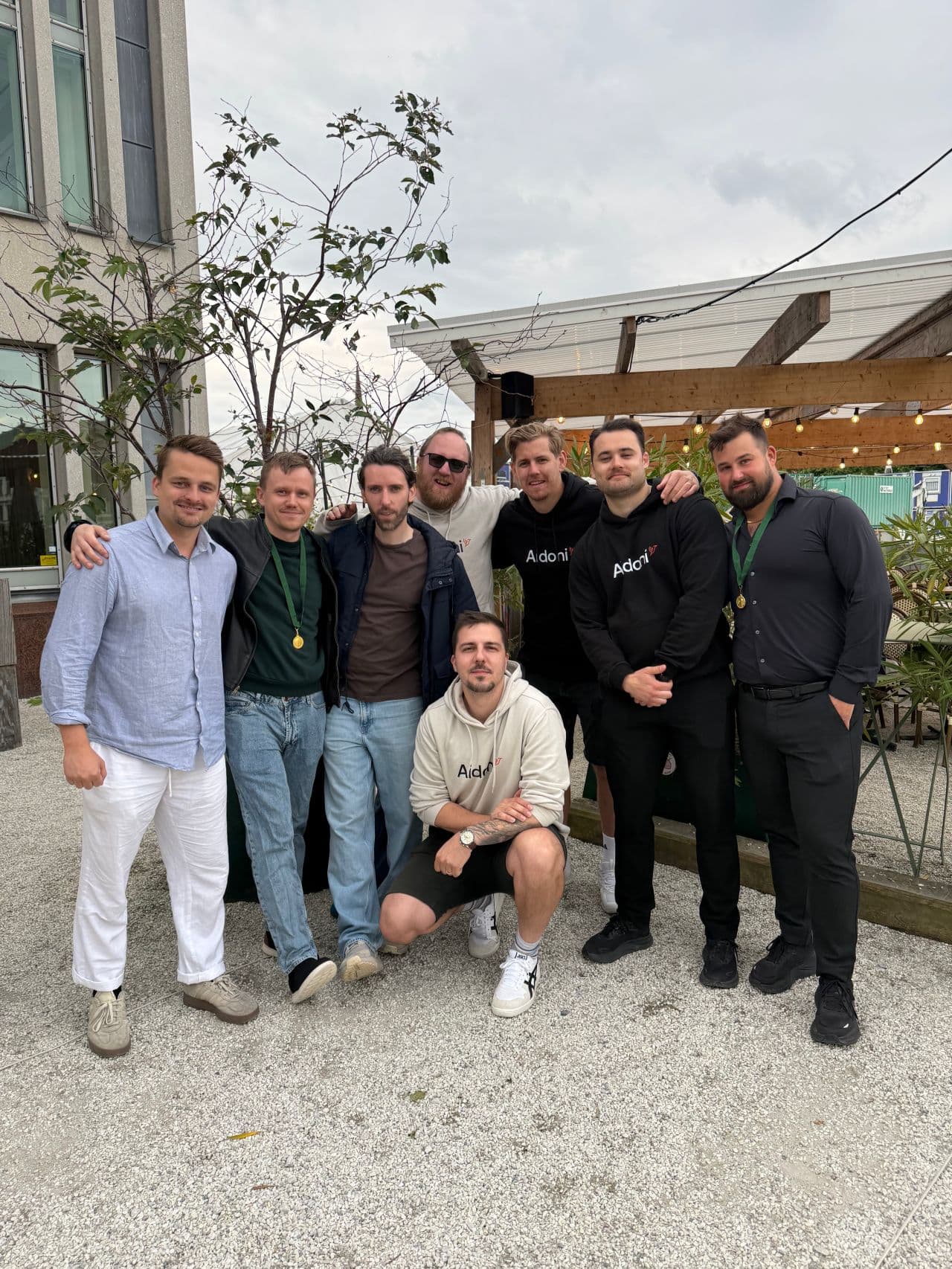
The Aidoni team together outdoors in Gothenburg